A Founder’s Guide to Grants: Sustainability Edition
Introduction: Why This Guide Now?
We published an article recently, where we explained how the world of innovation funding is changing, which you can read here. Grant funding can accelerate the enabling technologies that will have a real impact on the environment, economy and society across sectors, including climate tech, deep tech, and clean/green energy by supporting the technical risk part. In the UK grant funding typically aligns with the Industrial Strategy and Sector Plans for focused investment.
Sustainability startups and early stage SMEs face unique challenges such as high working capital intensity, long R&D cycles and regulatory hurdles, which can mean that there is a need the support of grant funding early on. This guide aims to demystify the funding landscape and provide you with a tactical plan for navigating grants for your early-stage or scaling business.
This guide is split into three sections:
Section 1: The basics. Introduces key concepts from the grant funding industry, helping you select the right grant.
Section 2: The curated list of grants and funders. The landscape is constantly changing, but this list will give you a good place to start your search.
Section 3: Improving your grant application. We give you six ways to help you write your grant to improve its chances of success.
This guide is for leaders and founders of startups and SMEs who are seeking grant funding at any of the key stages of development. It’s also for investors who want to learn more about grant funding to de-risk their investments in their portfolio.
Evaluate your grant readiness: Once you’ve read the Founder’s Guide, take the Grant Readiness Scorecard to check your readiness level here. It’s free and takes about three minutes to complete. It will provide a personal score benchmarking your ideas and processes against best practices, identifying strengths and weaknesses and providing next steps for improving your chances of success.
Section 1: The Basics
In this section, we outline the core ideas to give your project and grant application a strong start:
Start with your project idea and categorise it to decide which type of grant fits best.
Understand the financial requirements of the grant, in particular the match funding and eligible project costs. Some grants require match funding, meaning that the first part of the project is self-funded and costs are paid in arrears.
Have a grant strategy that considers using grants in a way that supports the development and evolution of your business and its products/services, alongside other forms of funding such as VC or angel investment.
Start with Your Project Idea
Before searching for funding, consider what your project idea is first. Perhaps grab a pen and paper and write down the project ideas that you have. Then prioritise the one that aligns best with the direction of your business and will add the most value to the development of your innovation.
With this project in mind, rate its maturity using the Technology Readiness Levels (TRL) system, originally developed by NASA. NASA created this measure to assess the maturity level of a technology throughout its lifecycle, and it is used widely by funding bodies.
Understanding your TRL is an important step, so you know what grant to apply for and which funder may support you. Applying for a large-scale deployment grant when you are still working at the lab bench will result in a quick rejection. With that in mind, we’ll guide you through what a TRL is and how this relates to different types of projects grant funders support.
Below is a very basic guide showing what kind of research is “accepted” at which stage, and also the percentage of funding that may be available to you. Also important to consider is what type of project you’ll want to do or perhaps need to do. Largely speaking, there are four types of projects:
Fundamental Research: Early-stage science to discover new knowledge, like experimenting with a novel catalyst, is purely exploratory.
Feasibility Studies: Small-scale, highly technically risky projects to test if your idea might really work and have commercial potential.
Industrial Research: Taking a prototype or early working version of the technology to test in a simulated environment.
Experimental Development: This has less technical risk compared to a Feasibility Study, and is closer to the end of the development lifecycle. This type of project may be a pilot or involve testing or validating new or improved technology in a real-life environment.

We’ll return to it later in this article, but it’s worth noting here that the funding gap will need to be filled by “match funding” from a low-risk financial option such as ringfenced funding within a raise from an angel investor, VC, loan in principle (where it’s released if the grant is won), or reinvesting profits.
Now, with your project categorised in mind, you can consider where your grant project fits into your funding strategy and how you will manage your funds.
Project Finances: Match Funding and Eligible Project Costs
As you may have spotted, some grant competitions fund between 45% and 70% of project costs, depending on the type of work. That means your business will need to provide the remaining match funding. Importantly, this money must be available in your account if you win, because Innovate UK (and most funders) pay in arrears, after checking claims such as receipts and timesheets. Match funding can come from investors, loans in principle, family and friends, or reinvested profits. What you should avoid is relying on uncertain sources like crowdfunding, where there’s no guarantee the money will be there when needed.
A common misconception is that match funding is part of the grant. It isn’t. If a grant covers 70% of costs and you’re awarded £100,000, that £100,000 represents just the grant share. You then need to add 30% match funding (£42,857), making your total project size £142,857. This is the figure that defines your eligible project costs.
It’s also worth noting that funding tiers are based on the total project size, not just the grant amount. So, if a competition has two tiers, “up to £500k” and “up to £1m”, then the maximum grant you could receive would be £350k in the first tier (70% of £500k) or £700k in the second tier (70% of £1m).
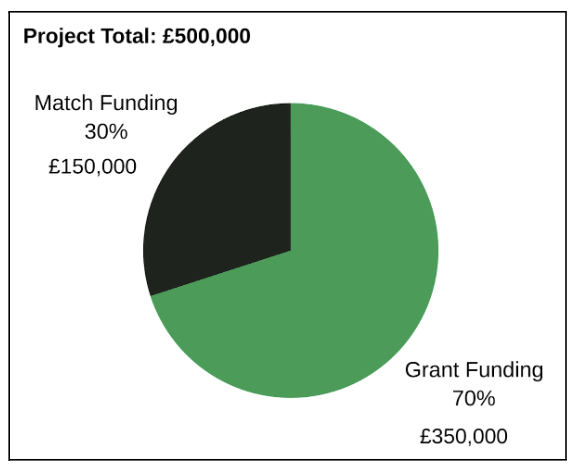
In this example, the maximum project total is £500,000. Meaning that the maximum grant funding total is £350,000 (70%). Sometimes this is misunderstood to be the £500,000 grant funding, as the 70% plus 30% match funding on top. This would make the total project cost £714,286, which is above the £500,000 and would therefore make the project ineligible.
There are requirements on what you can and cannot spend the grant funding on, which will impact the total project size and also the % of each type of spend, e.g. capital expenditure, subcontractors and labour. So, it’s important to get to know the eligibility criteria for project spend. Here is an example from UKRI. In addition, it’s worth noting that grant funding does not cover any costs that you’ve paid for before the grant project starts.
Grant Strategy: Taking a Holistic Approach to Your Funding Roadmap
For your grant strategy, consider where you are now, what you have the capacity and capability to deliver and the future direction of your business. These factors will help you decide on which grant projects to focus on and prevent you from trying to do too much on one project and rattle through the TRLs, as you’ll have a plan of how to use project types and grant funding to support steady and realistic innovation and R&D activity.
Trying to do too much in a grant project can be seen by some assessors as a red flag and cause rejection, and by others as a great way to get value and a huge ROI, holding you to the plan and the huge amount of work you’ve committed to. Either way, it's risky for you.
Having a clear plan for how you want to develop your TRLs can help to keep your project focused and achievable. This measured approach can also help you plan and forecast for your business how you want to grow, and develop the product/service, and how you’ll support it financially. Here is an example of how you may want to order your grant projects to fund their development.
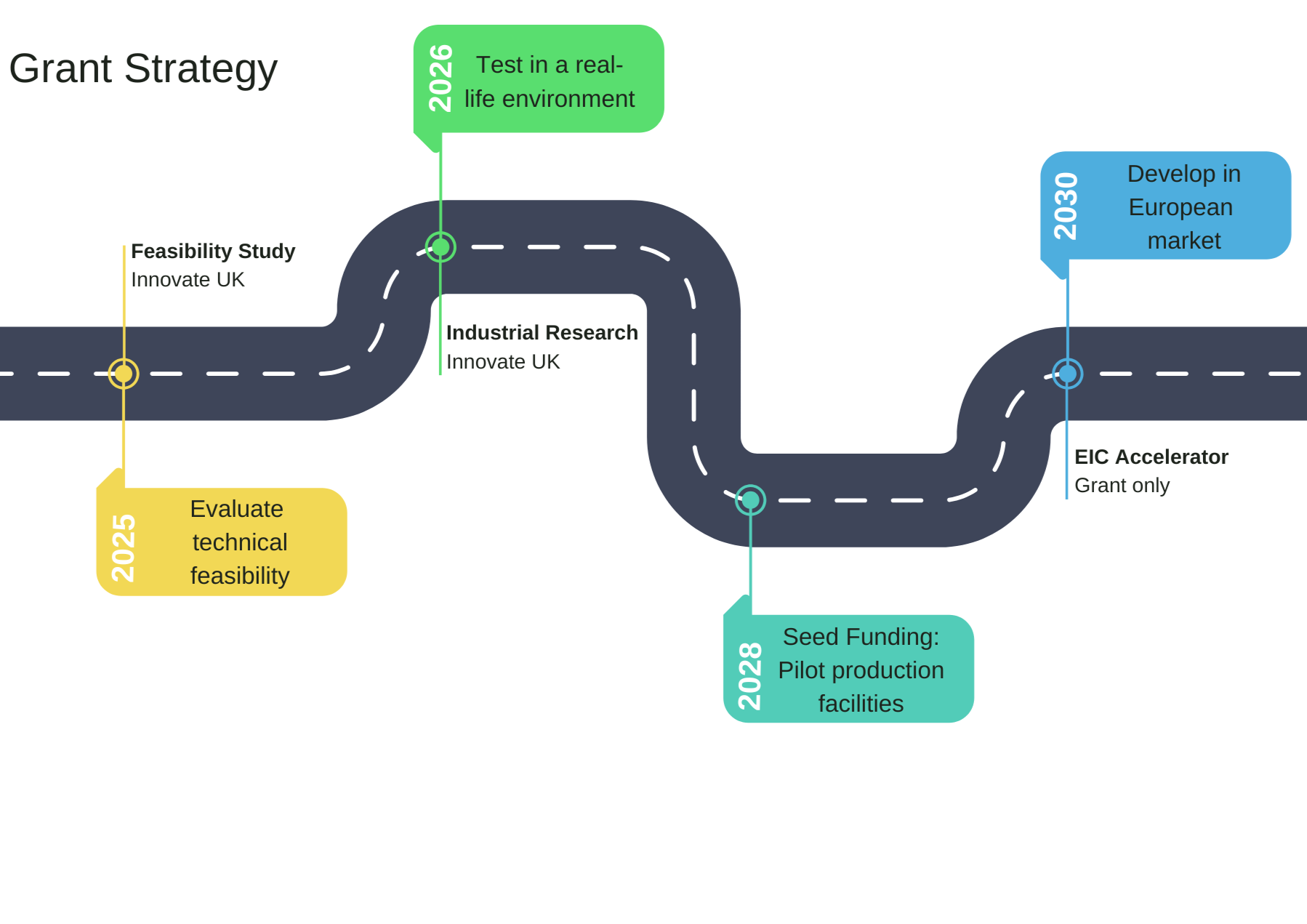
Now you have your categorised project, identified where it fits into the development journey of the business and technology and grant strategy, next is finding the right grant for your project and business.
Section 2: Where can I find grants?
Sustainability is multifaceted, with many different industries within it. This means there are many different sources of funding, which can make it difficult and confusing to know where to look.
To start, we’ll look at the five grant types:
Open competitions (e.g. SMART Scottish Enterprise): Broad calls you can enter with any breakthrough idea, regardless of sector.
Themed competitions (e.g. Innovate UK, Catapults, Government Departments, Find A Grant): Focused calls targeting specific industry or government challenges.
Local competitions (e.g UKSPF and Growth Hub): Regionally run funds to invest in local innovation, infrastructure and economic growth.
European competitions (e.g. Horizon Europe): EU-wide programmes funding collaborative research and innovation projects.
US and Global competitions (e.g. Hello Tomorrow Global Challenge): International contests showcasing world-class startups to global investors and partners.
Funders' budgets vary, as do their focuses; it’s a constantly changing landscape. Check the grant funds below and see if there are synergies between your product, your TRL, the budget available and their aims. To widen your search, consider the different angles on your project idea, from application to technical. For UK innovation grants, keep an eye on IUK Business Connect’s website for specific competitions.
We’ve listed the key EU and UK competitions, but we’ve probably missed some! So, help your fellow founders and leaders by adding your suggestions for where to find grants in the comments; you never know who you may be helping!
Energy/Net Zero
Ofcom’s Strategic Innovation Fund (via Ofgem & Innovate UK): A tiered grant competition funding feasibility, pilot, and live demonstrations to help energy network companies commercialise cutting‑edge ideas for net‑zero systems.
Horizon Europe Cluster 5 (Climate, Energy and Mobility): Europe-wide innovation grants for collaborative projects that advance zero‑carbon energy, climate resilience, and smart mobility under Horizon Europe.
Energy Catalyst: Innovate UK’s open-call grant for UK-led clean energy innovations that improve energy access in developing regions, offering both funding and accelerator support (planned for opening Summer 2025).
DESNZ Net Zero Innovation Portfolio (NZIP): A £1 billion UK government fund under DESNZ supporting commercialisation of low‑carbon energy tech across areas like CCUS, hydrogen, bioenergy, energy storage, and more (this stopped, but let’s hope this comes back).
EIT InnoEnergy: Part of the European Institute of Innovation & Technology (EIT), this initiative invests in and supports clean energy deep tech, from early-stage innovation to commercialisation and scale-up.
Deeptech
Cascade Funding: An EU open innovation model where SMEs can apply locally via consortium-led projects for small-scale innovation grants, often ideal for deep tech validation or piloting. One example is the women-led deep-tech funding call, Open Horizons.
EU funding portal: A comprehensive round-up of EU deep tech opportunities.
Agriculture (AgriTech)
DEFRA Farming Innovation Programme (FIP): A suite of grant competitions led by DEFRA and Innovate UK that help farmers, growers, and businesses explore, test, develop, and roll out sustainable agritech solutions.
ADOPT On-Farm Trials & Facilitator Support: Small-scale grants (£2.5 k facilitator or £50–100 k full grant) to help farmers develop and trial novel solutions directly on farms.
DEFRA blog: To be updated from Autumn 2025 with new opportunities.
UK Agri‑Tech Centre: Offers agritech startups access to expert insight, advanced R&D facilities, and collaboration support to take deep-tech solutions from concept to impact.
Launchpad – Agri‑Tech & Food Tech Cluster (Mid & North Wales): Regional Innovate UK-backed funding (up to £2.7 million) aimed at growing innovation in the agri-tech and food-tech sector locally.
Climate/Environment
EUKI – European Climate Initiative: A German-backed funding instrument aimed at cross-border climate-related deep tech projects, promoting cooperation across EU countries to reduce greenhouse gases. These are typically led by NGOs, authorities, non-profit organisations and universities.
Innovation Fund: One of the world’s largest programmes for low‑carbon and climate solutions, funded with revenue from the EU Emissions Trading System to support commercial-scale deep tech projects in areas like CCUS, sustainable energy storage, and green hydrogen.
Innovate UK’s Contracts for Innovation: Themed innovation contracts that solve specific government or industry challenges by funding real‑world prototyping and demos through competitions.
LIFE Programme (EU Environment/Climate Fund): Supports projects across the EU that focus on environmental protection, nature conservation, and climate action.
EIT Climate-KIC: Europe’s leading climate innovation accelerator network supporting sustainable deep-tech ventures with education, acceleration, and funding support.
EIT – Food / Raw Materials / Urban Mobility: Sector-specific EIT innovation communities offering funding, acceleration, and networks for deep-tech focused on food systems, resource use, and sustainable mobility.
Undaunted: The Greenhouse: Europe’s leading climate innovation accelerator, run by Imperial College London and the Royal Institution, offering early-stage green-tech startups support, networking, and up to £25,000 in non-equity funding.
We Rise: Women-Led: A Horizon Europe-backed programme that provides equity‑free funding, coaching, and investor matchmaking to women-led deep-tech startups in greentech, agritech, and climatetech across Europe.
ESA Climate Change Initiative: A European Space Agency effort that uses satellite observations to build long-term climate data records essential for monitoring global environmental change and guiding international climate action.
Cranfield University (Green Fund Investments): A university-backed fund offering grants, convertible loans, and technical support—including mentoring and access to test facilities—to UK innovators developing solutions for environmental and climate challenges.
Open competitions (UK)
Innovate UK Investor Partnerships: Combines an Innovate UK R&D grant with matched private investment from accredited investors to help early-stage deep tech startups scale effectively.
Innovate UK Innovation Loans: Offers loans from £100K to £5M for UK-registered businesses with high-growth, innovative proposals, providing a repayable alternative to grants.
UnLtd (Foundation for Social Entrepreneurs): Offers cash awards (£2.5K–£20K), mentorship, and support to UK-based social entrepreneurs, including sustainability-driven deep tech ventures.
Digital Catapult: Accelerator and R&D support across advanced tech verticals like AI, energy and quantum.
Future Leaders Fellowship: UKRI-backed funding (£110M total) providing multi-year support (~£300K–£3M per project) to nurture early-career innovators across sectors.
Open Competitions (EU)
FundingBox: FundingBox is the leading European facilitator of cascade funding (EU grants) for startups, scaleups, SME, midcaps, (e)Digital Innovation Hubs, universities and technology centres.
EIC Pre-Accelerator: A preparatory EU grant (€300K–€500K, 70% funded) to mature deep-tech innovations from TRL 4 toward TRL 5–6, designed to speed startups toward investment readiness.
EIC Accelerator: Offering up to €2.5 million in grants plus up to €15 million in equity to help deep tech SMEs scale breakthrough innovations in areas like clean energy or advanced materials.
Eureka Clusters: Industry-led, international R&D consortium grants (30–40% success rate) targeting strategic deep-tech themes across European countries.
Eurostars (Eureka Programme): Collaborative international R&D funding for SMEs developing market-ready innovations, typically moving from TRL 4 to TRL 6–7.
EIC Horizon Prizes: EU-wide inducement prizes rewarding anyone who solves a defined challenge, without prescribing how, typically with a cash award for the most effective solution.
EIC Pathfinder and Transition
EIC Pathfinder: Provides €3–4 million in grants for radically new deep tech ideas, from concept to lab validation.
EIC Transition Open 2025: Horizon Europe grants of up to €2.5M to validate tech in real-world settings (TRL 3/4 → TRL 5/6) and ready it for market applications.
Global
Fast Forward Accelerator: A three-month fellowship that provides early-stage tech nonprofits with a $25,000 unrestricted grant, mentorship, and a peer community to refine their impact-driven pitch and scale with social purpose.
Global Innovation Fund: Offers financing (grants, loans, or equity up to ~$15M) to organisations based anywhere, including the UK, with scalable solutions addressing global development challenges.
The Earthshot Prize: A prestigious global award that celebrates and propels innovative sustainability solutions with significant funding and visibility
Global Greengrants Fund: A global philanthropic foundation providing small-scale grants (USD 500–5,000) to grassroots sustainability projects around the world—including innovative deep tech initiatives.
UNIDO Climate Tech Innovation: A United Nations Industrial Development Organisation initiative backing climate-resilient, green industrial solutions through technology transfer, climate partnerships, and funding for cleaner manufacturing and cooling processes.
Hello Tomorrow Global Challenge: An annual deep-tech startup competition that gives early-stage innovators worldwide the chance to pitch breakthrough solutions (from biotech to cleantech and AI) to investors, corporates, and policymakers, with finalists gaining global visibility, funding opportunities, and entry into the Deep Tech Pioneers community.
Niche:
Corporate grants and accelerators with stipends such as Amazon Sustainability Accelerator, Ford Foundation and MassChallenge.
Defence and Security Accelerator (DASA) and Defence-Focused Innovation: Funds innovation in dual-use technologies with applications in defence, security, and broader tech sectors, often including sustainability or resilience.
DRIVE35 (Manufacturing Zero Emission Vehicles): UK firms can bid for up to £5M for feasibility studies and up to £40M for collaborative R&D and demonstrations to accelerate zero-emission vehicle technologies.
ARIA: A UK government-backed, high-risk/high-reward R&D funding body designed to catalyse breakthrough science and technological innovations with agility and minimal bureaucracy.
Section 3: Making Your Application Successful in Six Ways
You’ve identified a project, know your TRL and project type, and you’ve found a grant that meets the criteria. Now, you need a compelling application to secure funding. The six tips below will help you focus on the key areas that make a grant successful.
Show you know your customers early on. It’s great to show that you’re aware of the big picture problems but knowing your customer’s pain points too and why they’d buy your project gives assessors assurance that you’ll be able to commercialise it in the future.
Grant as a story. An approach that advocates having a tight, clear and consistent narrative throughout the whole application, with each question delving into one aspect of the story in more detail.
Back up claims and the impact your innovation will make, with evidence and data. Quantify impact as much as you can, and link to broader strategies and policies for more credibility.
A realistic commercial strategy that has a model behind it and not numbers plucked from thin air will strengthen your application. This underpins sales forecasting, market analysis, go-to-market strategies and IP strategy to maintain advantage.
Having a strong project plan and project team makes a huge difference, so knowing what your TRL is and how to pitch your project will help the assessors decide if it fits the brief.
Use AI and external feedback to refine and strengthen your grant application. The assessor criteria are generally publicly available and can be used as a basis for evaluation, and having an external view can help you refine your narrative. Be cautious using AI, make sure any citations, references and data are fully checked, and your application narrative is consistent, as sometimes AI can add its own flourishes. Use AI as a creative and research assistant, but make sure you fully understand and can explain and back the final copy.
Show you know your customers
Even if you’re in a long R&D cycle, it’s never too early to think about who you’re building for. Your customer value proposition is what will eventually carry your innovation into the world, because no matter how advanced your tech is, it only creates real impact if it solves a problem that matters to someone. Whether you’re selling B2C, B2B, or embedding yourself in a supply chain, the key is understanding your market.
In the sustainability space, many projects begin as a “tech push”, a new idea born in the lab, rather than a “market pull” where demand is already obvious. That’s why it’s so important to show funders that you know your customers and understand the market dynamics: what they’re willing to pay, what drives their decisions, and what barriers might stand in the way of adoption.
You don’t have to start from scratch. Tools like the Sustainable Business Model Canvas or the Planet-Centred Design Toolkit give you a structured way to map out customer segments, value propositions, and sustainability impacts. They help you design with people, the planet, and waste in mind from day one, making sure your innovation is anchored in real-world value.
When you back this up with real research from experts, market reports, and potential users, you derisk your project even further. Evidence from interviews, surveys, and customer validation shows reviewers that your claims are grounded in fact, not just aspiration. The more evidence, the better: Letters of Intent (LOIs) from potential customers or supply chain partners can turn a theoretical business case into something tangible. At best, they point directly to routes to market and revenue; at the very least, they show interest and intent, which is key in a grant application.
This is exactly where Sharp Insight can help. We’ve developed a dedicated grant application work package that brings together commercial research, competitor analysis, and customer insights. It’s designed to strengthen the business case around your innovation, giving funders confidence that the risks are managed and the opportunity is real. Find out more here.
2. Grant as a story: Align your narrative with the funder’s strategy
Storytelling is a useful tool to shape a strong narrative. Funders love a good story. A clear, compelling narrative doesn’t only make your grant application easier to read, it also shows you understand your customer and their world - what makes them tick and what they’re struggling with. Storytelling can bridge the gap between complex tech and real-world impact.
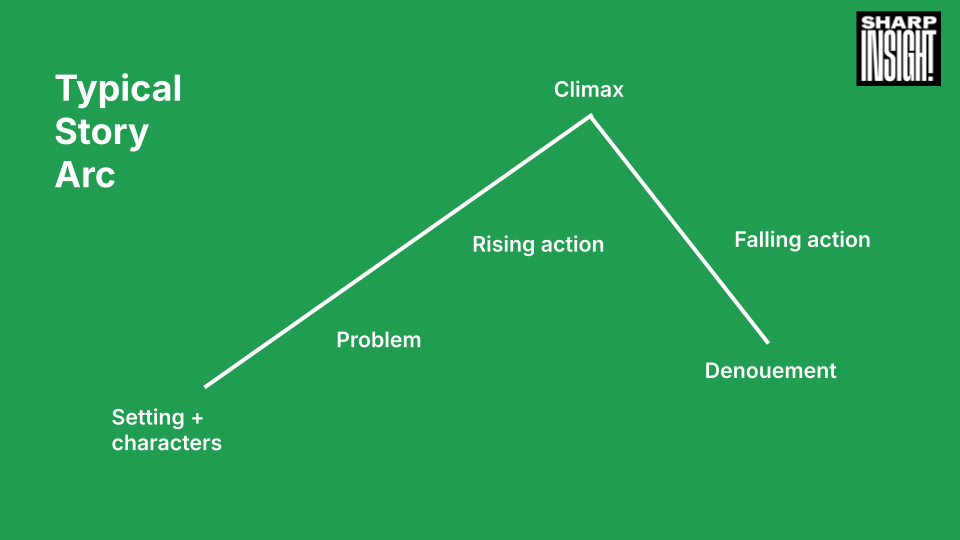
Every strong grant application reads like a story. No matter who the assessor is, stories are what make us human, and this tried and tested framework creates a clear narrative.
At the heart of it are the characters: your team, your partners, and the customers you’re building for. These are the people driving the innovation forward, and the ones who will benefit when it succeeds. Sometimes there’s even a “villain” in the narrative, for example, the pressing challenge of climate change, waste, or inefficiency that you’re determined to overcome.
Like any good story, it begins with a problem. You set the scene: what’s broken in the world today, why it matters, and what’s at stake if nothing changes. This serves as the background and outlines the tension that draws the reader in, the reason your story needs to be told.
From there, the narrative builds. The journey is your rising action. The path your team has taken, the technology you’re developing, and the obstacles you’ve faced along the way. This is where you show determination, creativity, and resilience, keeping the storyline connected to the bigger mission.
Then comes the climax, which is that breakthrough moment where things begin to turn. Maybe it’s your prototype working in real conditions, a pilot project with promising data, or a technical hurdle finally overcome. This is the proof point, the part of the story that tells the funder: yes, this can work.
Finally, every story seeks resolution, and this is your denouement. You paint a picture of what the world looks like if your project is funded: a product in the hands of real customers, emissions reduced, waste avoided, and communities benefiting, with evidence to make this case stronger. It’s not the end of the story, but a new beginning and one that the funder can support by joining you on this journey. They’d like to hear what their role would be in your story.
3. Back up claims and impact statements with clear evidence
When it comes to grants, impact needs to be tangible and measurable, particularly the impact and changes you say you will make. Funders need to know that your innovation delivers real, tangible benefits, not just good intentions.
Look at the frameworks, policies and strategies that relate to your project, Sustainability, Net Zero, Green Economy and the Industrial Strategy, that are tailwinds, demonstrating that there is a regulatory push. This is where you have an opportunity to stand out. Do not simply state that your project supports Net Zero. Instead, provide specific metrics:
Before: "Our technology will reduce carbon emissions in the logistics sector."
After: "Our technology will reduce carbon emissions by 15% per tonne-mile in the last-mile logistics sector, with a potential UK-wide reduction of 2 million tonnes of CO2 annually by 2035."
If a competition is targeted at a specific region, for example, your project must speak directly to that place. A plan to scale in Oxford won’t land well if the grant is designed to boost industrial capacity in Scotland. The reviewers are looking for alignment: why here, why now, why your solution.
But alignment alone isn’t enough. Funders want evidence and data. That’s where clear metrics come in. Imagine your product’s full journey, from design and build, through shipping and use, to end-of-life recycling or disposal. This lifecycle view reveals the true impact: carbon emissions saved, litres of water reduced, tonnes of waste diverted, jobs created, or costs avoided.
A lifecycle analysis (LCA) is a great way to prove that your project matters in its impact and how it could save energy, resources and emissions. For example, it’s not enough to say a cardboard deodorant tube is “better for the planet”; you need to show the numbers compared to the current situation: how much plastic is avoided, how much CO₂ is saved, and what percentage of the product is recyclable.
Funders will always lean toward projects that can quantify their claims, especially if it helps them reach their strategic goals. They want to back solutions where the benefits can be measured, compared, and scaled; it’s important to evidence all your claims and ensure they align with the funder’s strategy. So, the more you can translate your impact into numbers, supported by evidence, the stronger your application becomes.
Provide clear, credible, and referenced data for your market size, environmental impact, and job creation potential. No matter who the user of your product is, when you apply for a grant, the funder is your customer; treat them like it. Align yourself with their strategy, show value and measurable return on investment and your chances will improve.
Every funding call has specific eligibility criteria and questions. Read them multiple times and answer them directly. But go deeper: ask why this funding is being offered now? Is it to encourage collaboration between industry and academia? Your narrative must show how your project is the perfect answer to the funder's specific problem.
4. A realistic commercial strategy and using your IP to your advantage
Think of the funding assessor as an investor, but instead of investing their own money, they’re investing taxpayers’ money, so it needs to not just have economic, social and environmental impact, but a realistic plan to show it is commercially viable and will make a real difference. If your technology clearly meets the funding requirements, they want to support you. But they also need confidence that your commercial strategy stacks up and sounds viable because, from their perspective, weak or uncertain financials are one of the quickest reasons to reject an application in a very crowded field.
That’s where a sound commercial strategy makes all the difference. It’s not enough to showcase brilliant technology; you need to show you understand the market dynamics, your competitors, the growth potential, and the challenges ahead. Funders want to see that you’ve thought carefully about who your customers are, how you’ll reach them, and how this turns into sales and a go-to-market (GTM) plan. This derisks the commercial side of your project, making it clear that funding you isn’t just about great science, it’s also about a credible path to adoption.
Another aspect of your commercial strategy may be Intellectual Property (IP). Funders back innovations that compound value, not one-off activities. An IP strategy may cover securing and managing IP (patents, trade secrets, trademarks), ensuring freedom-to-operate, and converting rights into cash flows through multiple routes such as direct product sales, licensing (exclusive/non-exclusive, field-of-use), and co-commercialisation. IP comes in different forms, but from a grant funding perspective, there are two key ones.
First, there is foreground IP, the new knowledge, data, patents, or designs that will be created during the project. You’ll need to show how this will be protected, who owns it, and how it can be exploited after the project ends. A patent filing strategy, trade secrets, or design protections are all ways to secure your innovation and make it harder for competitors to catch up.
Second, there is background IP, the existing know-how, data, or patents you or your partners are bringing into the project. Funders want reassurance that you have the rights and freedom to use this IP, and that everyone involved understands how ownership and licensing will be handled. Being transparent about this at the start helps avoid disputes later and strengthens your credibility.
Show that you have a plan to use your IP to drive growth: expanding patents into international markets, developing licensing opportunities, or using it to defend your position in the supply chain. This is good business sense and directly ties into the funder’s priorities, like boosting UK exports, building industrial capacity, and reducing reliance on imports. A strong IP plan tells the assessor: this innovation is protected, market-ready, and capable of delivering lasting impact.
5. Having a realistic plan and a strong project team
A strong project plan demonstrates you have a clear, realistic roadmap to success using work packages to break it up into manageable pieces. You should show a logical progression from one stage to the next, with clear milestones, timelines, and deliverables that align with the project’s scope and Technology Readiness Level (TRL). A well-structured plan shows a realistic approach, proving you’ve thought through every step and are prepared for potential risks and have mitigation strategies for these.
A good plan is nothing without a good team. Funders want to see that your project has the right people in place to deliver on its promises and hit your milestones, managed by an experienced and capable project manager. Technical expertise is a given, but the team must have the capability and capacity to deliver the project as well as commercial expertise to develop relationships and opportunities for the innovation post-project.
Funders also look for strong collaboration. As we mentioned when talking about IP collaboration, including partners like universities, public sector organisations or other SMEs that align with the project's goals can significantly strengthen your application. These collaborations can bring in specialist expertise, additional resources, and credibility, showing that your innovation is part of a wider ecosystem of support.
There are two different types of collaborators, the first is a partner who can invest in the project, as they’ll need to contribute match funding if they’re a business. If they’re a Research and Technology Organisation (RTO), which is a not-for-profit knowledge organisation or an academic organisation, they would not need to contribute match funding. Universities have their own way of working out their contribution, using the Full Economic Costs approach. They have 80% of their costs covered by the grant. For example, a university may be a partner at £100,000 and in the application, this is covered by the grant, but the university itself would receive £80,000 and need to cover the £20,000. A subcontractor delivers one part of the project but doesn’t have the same level of interest or involvement as a partner.
6. Using AI and getting feedback to refine your narrative
Before you hit “submit,” make sure fresh eyes have read your application, so leave enough time for a review phase when you’re planning your time in investing in writing a grant application. If someone who isn’t close to your project can’t easily understand your vision, your value, and why it matters, the chances are, an assessor won’t either.
The good news is you don’t have to do this alone. Innovate UK Business Connect offers free feedback on applications, and many specialist grant writing consultancies (including us at Sharp Insight) provide review services to help refine your proposal. If you need deeper support, we can even partner as a research collaborator to co-author bids. Whatever route you choose, getting external input almost always makes your application sharper, clearer, and more competitive.
And of course, the big topic everyone’s asking about: AI in grant writing. If you used AI to write your grant application, that’s not necessarily a bad thing. Tools like ChatGPT, Claude or Gemini can be great as a coach or collaborator for brainstorming ideas, learning about key concepts, or drafting early text. But relying on them to write an entire application is risky because AI doesn’t yet have the strategic nuance to align your project with a funder’s regional or policy goals, and it can’t replicate the authentic passion that assessors look for, so if you do use it, make sure you check it carefully. It can misinterpret data, muddle numbers, or strip out the unique voice of your business and take it from rich and in-depth to high-level and fluffy. Assessors read hundreds of applications, and “AI-sounding” language is getting easier to spot, especially when they have those summaries at the end, which are using up valuable word count!
Key Takeaways
Navigating the grant landscape can feel complex, but at the heart of it, it’s a way to test and strengthen your business strategy and get insightful feedback on your development plans. Success comes from showing you have a business case worth funding. If you remember only three things from this guide, let them be these:
First, ensure your project is strategic for your business and is a good fit for the competition. Before you start scanning open calls, take time to know your Technology Readiness Level and where this project fits on your commercial roadmap. A grant should serve a specific stage of your journey. Reviewers are drawn to focused, well-defined projects that feel like natural next steps rather than broad leaps trying to cover too much at once.
Second, see the funder as your most important customer. They are decision-makers of the use of public money and are accountable for its impact. Your application has to show how your project helps them achieve their goals, whether that’s regional economic growth, supply chain resilience, or progress on Net Zero. Make it easy for them to see your proposal as a credible, low-risk investment with a clear return and the hero in your narrative.
Finally, ground your vision in evidence. A compelling story captures attention, but it’s evidence that builds confidence. Use market research to demonstrate customer need, a lifecycle analysis to quantify environmental benefits, and a commercial plan that shows a clear path to market. Together, these elements turn your innovation into an opportunity that feels both exciting and reliable.
Our aim with this guide is to give you clarity and confidence in this process, so you can secure the right funding and stay focused on what matters most: growing a business with impact. If you want to evaluate where you’re at with grant funding, check out our Grant Readiness Scorecard here.
About the Author:
Over the past decade, Dr Chloe Sharp has secured over £10 million in non-dilutive funding for founders in digital tech, deep tech, sustainability, and life sciences. Dr Chloe Sharp, author of Make Products That Matter, founded Sharp Insight, which provides innovative thinking and strategic insight for founders and their teams, helping them validate their innovation, de-risk their strategy, and grow their business.
If you are looking for customer research, support building a commercial strategy to build a sustainable business after your grant project, book a free call with Chloe here.